The organizations and sites listed on this page offer Registry Approved training for Illinois child care providers. These links take you to pages outside of the Gateways i-learning System, and INCCRRA and Gateways are not responsible for technical assistance or support for any content provided through these entities.
Search results: 34
This training explores the fundamental principles of adult learning theory, examining key questions such as how and why adults engage in learning. With this theoretical framework as a foundation, we will discuss the trainer's role in the adult learning process, as well as strategies for creating and delivering an enriching learning experience. The training also addresses common challenges and offers practical approaches for preventing issues before they arise. This training is required for all ITN and Registry Trainers.
Contact Hours: 2 hours Gateways Content Areas: PPD (2 hours) CDA Content Areas: 6 (2 hours)

An Introduction to Transitions discusses the effects of various types of transitions - including activity, classroom, program, family, and community - on families and a child's learning and development. This course will provide strategies to assist families in times of transition, as well as, identify specific types of transitions that impact children and families.
This Registry-approved training is brought to you by Gateways to Opportunity®. This training is ExceleRate-approved and counts towards ExceleRate™ Illinois for licensed child care centers and DCFS licensed program training hours.
Esta capacitación está disponible en español aquí.

This course is intended to provide ECE, CFC, and LEA staff
and administrators with a deeper understanding of the available tools and
resources to help foster partnerships and implement best practices that promote
inclusion. Building Relationships to
Support Inclusion in Early Childhood: Tools to Support your Efforts is
brought to you by the Illinois Early Learning Council Inclusion Subcommittee,
in collaboration with state agency partners at the Governor’s Office of Early
Childhood Development, Illinois State Board of Education, and the Illinois
Department of Human Services.
Contact Hours: 1 Hour Gateways Content Areas: IRE (1 hour) CDA Content Areas: 6 (1 hour)

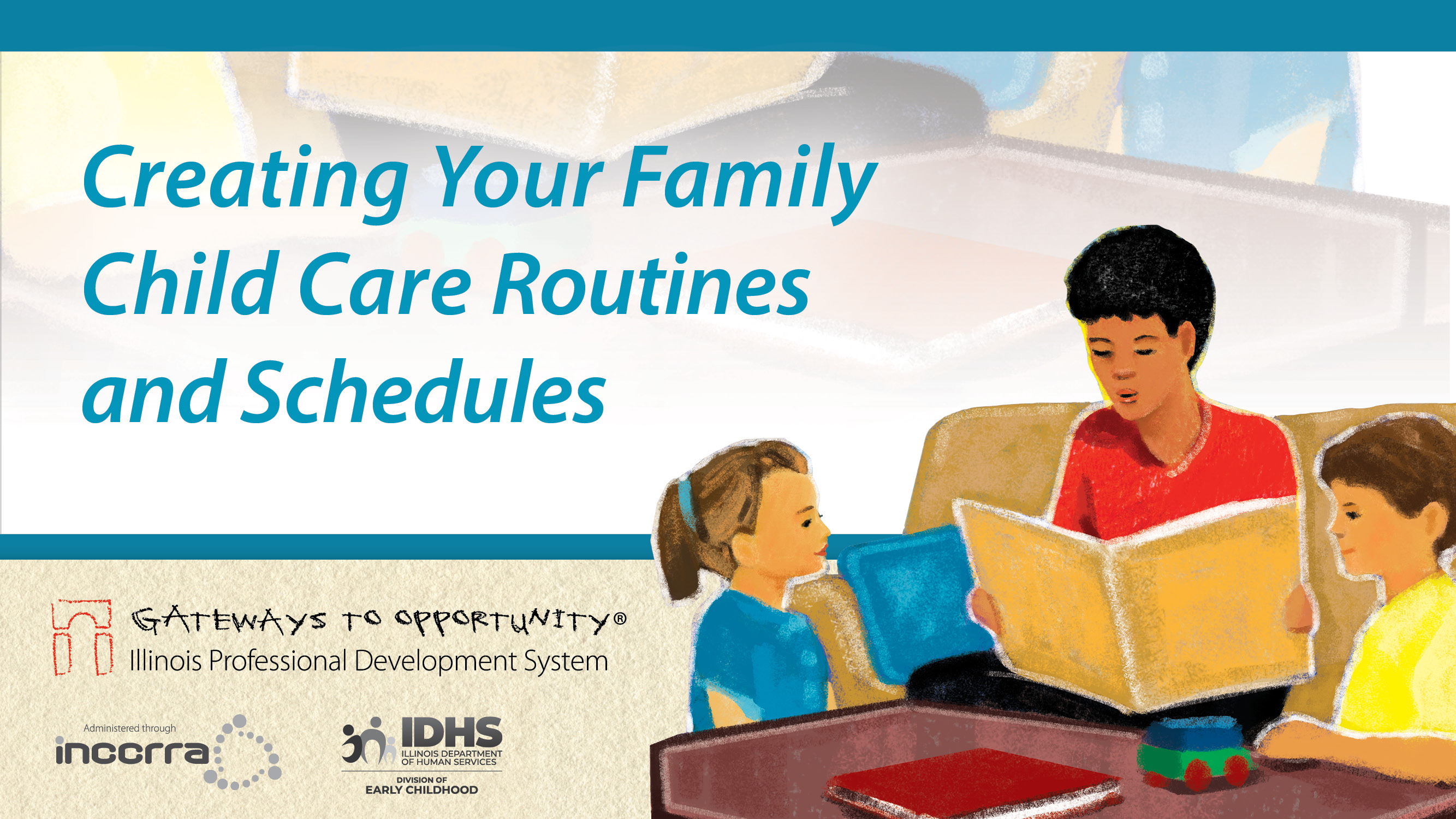
In this training, Creating Your Family Child Care Routines and Schedules, participants will learn to describe the importance of routines and schedules in a family child care program, identify essential components of effective routines and schedules, and create sample routines and schedules that will support healthy development, learning, and well-being in a family child care program. **Taking this training will not earn you a Family Child Care Credential. That process involves working with a Credentials Counselor.**
Topics include:
- Importance of Routines and Schedules
- Balancing Needs
- Developing Effective Schedules
- Daily Routines
- Transitions

Curiosity and Wonder is the second course in a nine-part series designed to support science competencies in teachers of young children. Please make sure to take the Introduction course before taking this 2nd course in the series. Curiosity and wonder is central to young children’s science explorations and learning. In this course we will examine what curiosity and wonder are and how they can support children in all areas of early science.
This training provides 1 contact hour of Gateways Registry-Approved training and 1 Continuing Professional Development Unit (CPDU).
Please make sure to take the following Early Science Matters Professional Development Program course before you take this course:
Course 1: Introduction
Contact Hours: 1 hour Gateways Content Areas: CPD (1 hour) CDA Content Areas: PI (1 hour)
Module 4 - Learning Happens in Relationships
Our kids are constantly responding to family members, teachers, and social relationships that help to shape their understanding of the world around them. This module explores how relationships between families, children and teachers can help learning, and how crafting the environment around them can help children learn.
Contact Hours: 2 hours Gateways Content Areas: CPD (1 hour); IRE (1 hour) CDA Content Areas: 1 (1 hour); 3 (1 hour)Esta capacitación está disponible en español aquí.

Module 5 - Family and Community Relationships
As our partners in child development, families, and especially parents, directly affect a child's learning. In this module you will learn the new ways of working with parents to help their children enjoy learning. You also will explore the social world of a family to be sure that the learning that takes place in your care is consistent with the learning done at home.
Contact Hours: 2 hours Gateways Content Areas: FCR (2 hours) CDA Content Areas: 4 (2 hours)Esta capacitación está disponible en español aquí.

Module 7b - Child Development: Ages 8 to 18 Months
In this continuation of the first child development module, you will explore development among children ages 8-18 months. You'll identify how this age group differs in growth and their approach to learning, and you'll discover toys, games and songs that are helpful and just right for their development.
Contact Hours: 2 hours Gateways Content Areas: HGD (2 hours) CDA Content Areas: 3 (1 hour); 8 (1 hour)Esta capacitación está disponible en español aquí.

Module 8d - The Preschool-Age Child: Cognitive Development
In this module on preschool development, you will dive deeper into how preschoolers learn and identify tips for making learning fun. With suggestions for activities that encourage your preschoolers to explore numbers, shapes, colors and science, this module gives all the information you need to grow and stretch the ability of children to think and understand.
Contact Hours: 2 hours Gateways Content Areas: HGD (1 hour); CPD (1 hour) CDA Content Areas: 2 (2 hours)Esta capacitación está disponible en español aquí.

Module 9 - School-Age Development
This module on child development looks at school-age children to uncover how their learning and growth differs. With tips on how to better care for school-aged youth, this module offers you guidance on how to set rules and limits and to get your school-aged kids to appreciate safety and respect.
Contact Hours: 2 hours Gateways Content Areas: HGD (1 hour); CPD (1 hour) CDA Content Areas: 2 (1 hour); 8 (1 hour)Esta capacitación está disponible en español aquí.

Module 4 - Learning Happens in Relationships
Our kids are constantly responding to family members, teachers, and social relationships that help to shape their understanding of the world around them. This module explores how relationships between families, children and teachers can help learning, and how crafting the environment around them can help children learn.
Contact Hours: 2 hours Gateways Content Areas: CPD (1 hour); IRE (1 hour) CDA Content Areas: 1 (1 hour); 3 (1 hour)Module 5 - Family and Community Relationships
As our partners in child development, families, and especially parents, directly affect a child's learning. In this module you will learn the new ways of working with parents to help their children enjoy learning. You also will explore the social world of a family to be sure that the learning that takes place in your care is consistent with the learning done at home.
Contact Hours: 2 hours Gateways Content Areas: FCR (2 hours) CDA Content Areas: 4 (2 hours)Module 7b - Child Development: Ages 8 to 18 Months
In this continuation of the first child development module, you will explore development among children ages 8-18 months. You'll identify how this age group differs in growth and their approach to learning, and you'll discover toys, games and songs that are helpful and just right for their development.
Contact Hours: 2 hours Gateways Content Areas: HGD (2 hours) CDA Content Areas: 3 (1 hour); 8 (1 hour)Module 8d - The Preschool-Age Child: Cognitive Development
In this module on preschool development, you will dive deeper into how preschoolers learn and identify tips for making learning fun. With suggestions for activities that encourage your preschoolers to explore numbers, shapes, colors and science, this module gives all the information you need to grow and stretch the ability of children to think and understand.
Contact Hours: 2 hours Gateways Content Areas: HGD (1 hour); CPD (1 hour) CDA Content Areas: 2 (2 hours)Module 9 - School-Age Development
This module on child development looks at school-age children to uncover how their learning and growth differs. With tips on how to better care for school-aged youth, this module offers you guidance on how to set rules and limits and to get your school-aged kids to appreciate safety and respect.
Contact Hours: 2 hours Gateways Content Areas: HGD (1 hour); CPD (1 hour) CDA Content Areas: 2 (1 hour); 8 (1 hour)The benefits of strong family and community engagement practices in the child care setting will be presented in the course. Participants will identify the strengths of current family and parent policies, as well as determine strategies to develop a strengths-based family and community engagement plan.
Contact Hours: 3 hours Gateways Content Areas: FCR (3 hours) CDA Content Areas: 4 (3 hours)
Esta capacitación está disponible en español aquí.

This 3-hour course will introduce the assessment cycle for young children and its importance in the early childhood program. Early childhood practitioners will discover differences in assessment tools and how assessment may impact the classroom learning environment. Participants will review strategies for family engagement when sharing results.
This Registry-approved training
is brought to you by Gateways to Opportunity®. This training
is ExceleRate-approved and counts towards ExceleRate™ Illinois for
licensed child care centers and DCFS licensed program training hours.

This training is for center-based programs and family child care providers and offers a general, introductory overview of the Environment Rating Scales (ERS). The Environment Rating Scales are research-based, user-friendly assessment tools that measure the quality of the learning environment for infants through school-age children. After completing this training, participants will have general knowledge of the common terms used within the ERS, learn resources available and be able to use the tool(s) for program self-assessment and improvement planning.
Note: Participant is responsible for purchase of Scale used within their program/classroom. It is recommended to continue and complete Scale-specific training on the tool you use.
Contact Hours: 2 hours Gateways Content Area: IRE (2 hours) CDA Content Areas: 5 (2 hours)


This online course is an introduction to the Illinois Early Learning Guidelines for Birth to Age Three (IELG). The content in this course will cover the history, purpose and role of the Illinois Early Learning Guidelines, aid participants in developing a working knowledge of IELG and provide resources for the implementation of the IELG.
Contact Hours: 3 hours Gateways Content Areas: HGD (1 hour); OA (1 hour); IRE (1 hour) CDA Content Areas: SE(1 hour); OB (1 hour); CD (1 hour)Esta capacitación está disponible en español aquí.

Midwest Pesticide Action Center, in collaboration with the Illinois Network of Child Care Resource and Referral Agencies, has developed an online learning module to provide all Illinois child care providers with an overview of pest control strategies and requirements. In this presentation, you will become familiar with what the laws are for pest control in child care programs, be provided with a general overview of what Integrated Pest Management (IPM) is, and receive a list of the basic steps for putting an IPM program in place. Ultimately, the goal of this presentation is to provide you with the tools you need to reduce the exposure of you and the children you care for to pests and pesticides.
Contact Hours: 1 hour Gateways Content Areas: HSW (1 hour) CDA Content Areas: 1 (1 hour)
This introductory ECERS-3 training explains how to create engaging play-based learning experiences for young children and support meaningful interactions with adults and peers. You will explore how to plan and enrich your classroom space and materials across the ECERS-3 subscales and items such as fine motor play, art, dramatic play, nature and science, math, etc. Language and Literacy items are also explored, with tips for building vocabulary, engagement with books, and encouraging communication.
Note: Participant should have a copy of the ECERS-3 with you when completing the training.
Contact Hours: 1 hour Gateways Content Areas: OA (1 hour) CDA Content Areas: 5 (1 hour)

This introductory ITERS-3 training explains how to create engaging play-based learning experiences for young children and support meaningful interactions with adults and peers. You will explore how to plan and enrich your classroom space and materials across the ITERS-3 subscales and items such as fine motor play, music and movement, dramatic play, nature and science, math, etc. Language and Books items are also explored, with tips for building vocabulary, engagement with books, and encouraging communication.
Note: Participant should have a copy of the ITERS-3 with you when completing the training.
Contact Hours: 1 hour Gateways Content Areas: OA (1 hour) CDA Content Areas: 5 (1 hour)
A Systems Framework: Understanding the Process of I/ECMH Consultation
This module addresses the systems that I/ECMHC interfaces with. Participants will learn about system’s perspectives generally and begin to understand the settings that I/ECMH consultants work within, both formal and informal. The module explores how learning and change take place and supports consultants toward understanding their role and their relationships as change agents toward better child and family outcomes within a systems context.
Contact Hours: 2 Hours Gateways Content Area: PPD (2hours) CDA Hours: 6(2 hours)

Supporting Teachers in Consultation by Mastering Principles of Adult Learning Theory
Designed to introduce an understanding of the Principles of Adult Learning in the I/ECMH Consultant’s role. Because adult learners receive information differently, it is important to understand what is required when working with them in consultation. Consultants in this training will build a foundation for their work with teachers by exploring the various types of learning theories and discovering strategies for their use. Information learned in this training will assist the consultant in supporting teachers’ goals of enhancing children’s social, emotional, and mental development by enhancing the social, emotional, and mental climate of their classroom.
Contact Hours: 2 Hours Gateways Content Area: PPD (2hours) CDA Hours: 6(2 hours)This is the assessment portion of the PITC Module 3: Learning and Development course. Participants will receive credit for the PITC Module 3 training upon completion of this portion of the course.
Contact Hours: 1
Gateways Content Area & Credential Competency: ITC - HGD1, HGD2, CPD2
Esta es la parte de evaluación del curso Módulo PITC 3: Aprendizaje y desarrollo. Los participantes recibirán crédito por la capacitación del Módulo 3 del PITC al finalizar esta parte del curso.
Horas de contacto: 1
Áreas de contenido de Gateways y Competencia de credenciales: ITC - HGD1, HGD2, CPD2
This is the assessment portion of the PITC Module 3: Learning and Development course. Participants will receive credit for the PITC Module 3 training upon completion of this portion of the course.
Contact Hours: 1
Gateways Content Area & Credential Competency: ITC - HGD1, HGD2, CPD2
Esta es la parte de evaluación del curso Módulo PITC 3: Aprendizaje y desarrollo. Los participantes recibirán crédito por la capacitación del Módulo 3 del PITC al finalizar esta parte del curso.
Horas de contacto: 1
Áreas de contenido de Gateways y Competencia de credenciales: ITC - HGD1, HGD2, CPD2
This is the assessment portion of the PITC Module 3: Learning and Development course. Participants will receive credit for the PITC Module 3 training upon completion of this portion of the course.
Contact Hours: 1
Gateways Content Area & Credential Competency: ITC - HGD1, HGD2, CPD2
Esta es la parte de evaluación del curso Módulo PITC 3: Aprendizaje y desarrollo. Los participantes recibirán crédito por la capacitación del Módulo 3 del PITC al finalizar esta parte del curso.
Horas de contacto: 1
Áreas de contenido de Gateways y Competencia de credenciales: ITC - HGD1, HGD2, CPD2
This is the assessment portion of the PITC Module 3: Learning and Development course. Participants will receive credit for the PITC Module 3 training upon completion of this portion of the course.
Contact Hours: 1
Gateways Content Area & Credential Competency: ITC - HGD1, HGD2, CPD2
Esta es la parte de evaluación del curso Módulo PITC 3: Aprendizaje y desarrollo. Los participantes recibirán crédito por la capacitación del Módulo 3 del PITC al finalizar esta parte del curso.
Horas de contacto: 1
Áreas de contenido de Gateways y Competencia de credenciales: ITC - HGD1, HGD2, CPD2
In this training, Planning Your Family Child Care Environment, participants will learn to describe and identify strategies to create a family child care environment that supports multiple uses, including: providing quality care for a mixed age group of children, managing a successful home business, and meeting the needs of their own family. **Taking this training will not earn you a Family Child Care Credential. That process involves working with a Credentials Counselor.**
Topics include:
- Foundations of effective planning
- Environmental health and safety
- Importance of the daily schedule
- Planning your outdoor learning environment
- Furniture and material selection
Contact Hours: 2 hours Gateways Content Area: CPD (2 hours) CDA Content Area: Program Management (2 hours)

Preschool children are developing quickly in all areas. This session will discuss how providers can support their development by helping them interact within their worlds on many levels: through their senses, through play, and through movement. Their experiences create a framework for learning that will carry them through later stages of development and into adulthood.
This Registry-approved training is brought to you by Gateways to Opportunity.
Contact Hours : 2 hours Gateways Content Area: HGD (2 hours) CDA Content Area: 8 (2 hours)
Find resources and tools to assist you in completing your online learning.
Trauma-Informed Practice for Child Care Providers explores concepts in a variety of areas including infant/early childhood mental
health, social emotional development of young children, and trauma and adverse childhood experiences. You will look at indicators and benchmarks
and ways to foster social emotional learning in culturally
responsive ways. This training meets the DCFS requirement for trauma-informed care.
Contact Hours: 2 hours Gateways Content Areas: HSW (2 hours) CDA Content Areas: Health & Safety (1 hour) and Social/Emotional (1 hour)
Esta capacitación está disponible en español aquí.